

The Ultimate Guide to Washing Machine Repair: Fixes, Costs, and Expert Advice
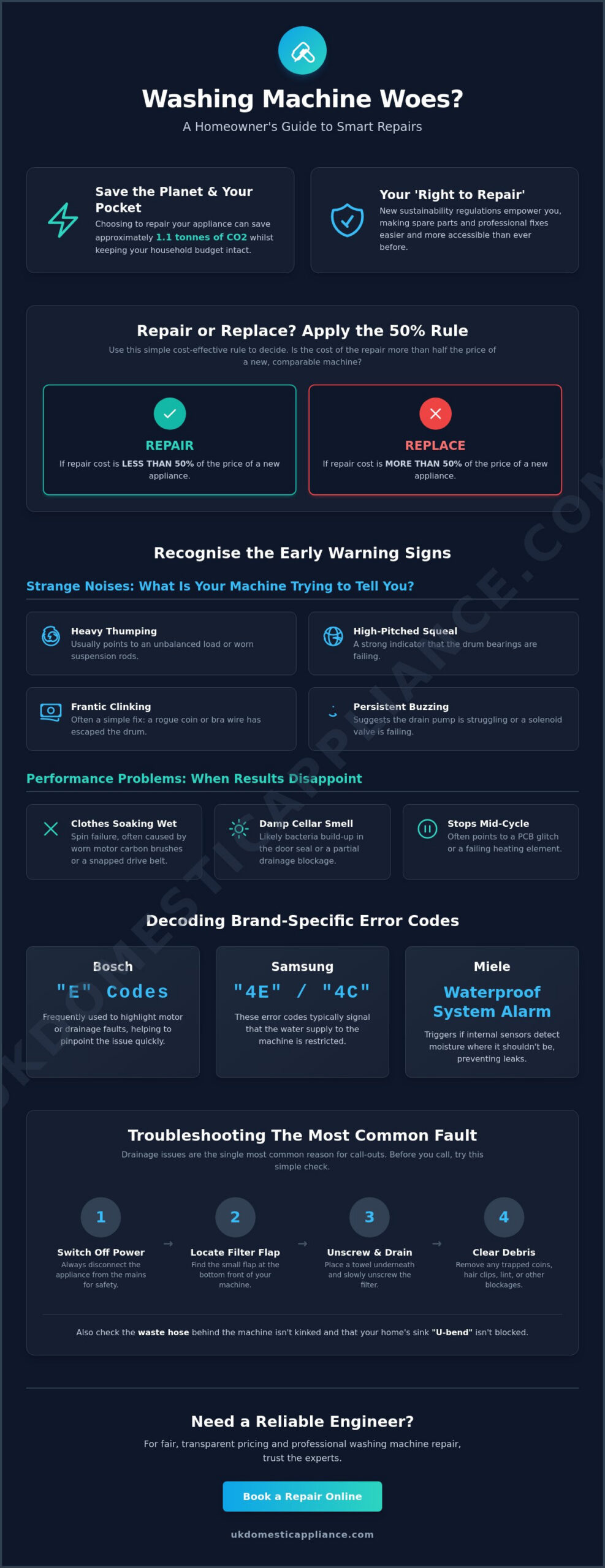
Did you know that choosing to repair your appliance instead of scrapping it can save approximately 1.1 tonnes of CO2 while keeping your household budget intact? It’s a staggering figure, yet many homeowners feel forced into an expensive replacement they don’t actually want. When the drum stops spinning and the laundry starts mounting, the pressure to make a snap decision is intense. You’re likely worried about the hidden costs of washing machine repair or, even worse, being overcharged by an unreliable engineer who leaves you with a bigger mess than you started with.
We understand that a broken appliance is more than just a minor inconvenience; it’s a total disruption to your family’s daily rhythm. This guide will help you master the essentials of washing machine repair so you can save money, avoid domestic stress, and keep your home running smoothly. We will explore how to identify fair pricing, explain the “50% rule” for deciding when to fix or replace, and show you how new “Right to Repair” regulations are putting the power back in your hands for a quick, reliable resolution.
Key Takeaways
- Learn how to recognise the early symptoms of mechanical failure to prevent minor faults from becoming expensive emergencies.
- Discover how to apply the “50% Rule” to determine if a washing machine repair is the most cost-effective choice for your household budget.
- Understand your rights under the latest sustainability regulations that make finding spare parts and professional fixes easier than ever.
- Identify the essential qualifications and local expertise required to choose a dependable engineer in London who offers fair, transparent pricing.
Common Washing Machine Faults: Identifying the Warning Signs
Recognising a fault before it transforms into a kitchen flood is the secret to stress-free home maintenance. Most mechanical issues follow a clear hierarchy. A rattling sound during the spin cycle is usually a minor annoyance, but a puddle appearing on your lino is a critical safety risk. Ignoring that small drip today is a gamble; water damage spreads quickly, often leading to rotted floorboards and mould growth that cost significantly more to fix than a simple door seal. For a deeper look at how these units operate, this comprehensive guide to washing machines covers the evolution of domestic laundry technology.
Modern appliances are sophisticated, and different brands have their own ways of signalling for help. Bosch machines frequently use “E” codes to highlight motor or drainage faults. Samsung models might show a “4E” or “4C” error when the water supply is restricted. Even premium Miele units will trigger a waterproof system alarm if internal sensors detect moisture where it shouldn’t be. Identifying these brand-specific quirks early is the first step toward a successful washing machine repair.
Strange Noises: What Is Your Machine Trying to Tell You?
Your machine often talks to you before it gives up entirely. A heavy thumping usually points to worn suspension rods or an unbalanced load. If you hear a high-pitched squeal that sets your teeth on edge, your drum bearings are likely failing. Sometimes the cause is simpler; a frantic clinking often means a rogue 50p piece or a bra wire has escaped the drum. A persistent buzzing? That’s usually a sign that your drain pump is struggling with a blockage or a solenoid valve is failing. Prompt attention to these sounds makes the eventual washing machine repair much simpler and cheaper.
Performance Issues: When Clothes Come Out Dirty or Sopping Wet
Sometimes the machine sounds fine, but the results in the drum tell a different story. It’s frustrating when your laundry comes out sopping wet. This spin failure often stems from worn carbon brushes in the motor or a snapped drive belt. If your machine smells like a damp cellar, you’re likely dealing with bacteria build-up in the seal or a partial drainage blockage. Perhaps the most confusing issue is when a machine simply stops mid-cycle without a single error code. This often points to a PCB (Printed Circuit Board) glitch or a heating element failure that prevents the next stage of the programme from starting.
Troubleshooting 101: Why Your Machine is Not Behaving
Understanding what happens beneath the casing can demystify the entire washing machine repair process. Think of your appliance as a coordinated team of components. At the centre of it all is the Printed Circuit Board (PCB). This is the “brain” of your machine; it sends electrical signals to the motor, valves, and sensors to ensure every cycle runs in the correct order. If the PCB glitches, the whole system can stall, leaving you with a drum full of soapy water and a lot of frustration.
The PCB relies on feedback from various parts to do its job. For example, the pressure switch monitors the water level. Once it confirms the drum is full, it signals the heating element to begin warming the water. These two parts work in tandem; if the pressure switch fails to report the correct level, the heater won’t activate to protect the machine from overheating. Understanding these connections is vital when researching consumer rights on appliance warranties and determining if a fault is covered by a manufacturer’s promise or requires a private fix.
The Drainage System: Pumps, Filters, and Hoses
Drainage issues are the single most common reason for professional call-outs. Before you panic, check your pump filter. Simply switch off the power, open the small flap at the bottom front of the machine, and slowly unscrew the filter to clear out any trapped coins, hair clips, or lint. Always keep a towel handy for excess water. Sometimes the fault isn’t mechanical at all; a kinked waste hose behind the machine can mimic a total pump failure. Additionally, the physics of your home’s “U-bend” can cause issues. If your sink plumbing is blocked, the dirty water has nowhere to go but back into your appliance.
Electrical and Motor Faults: Beyond the Basics
If your drum isn’t turning, the culprit is often the motor’s carbon brushes. These small blocks conduct electricity to the spinning part of the motor and naturally wear down over time. You might notice small sparks or a faint clicking sound before the motor stops entirely. In a busy city like London, sensitive electronics are also vulnerable to subtle power surges on the grid, which can occasionally “fry” a PCB. The heating element’s lifespan is typically 5-10 years depending on water hardness. If you’re hesitant to handle these internal electrical components, the expert team at UK Domestic Appliance can provide a safe and efficient washing machine repair to get your routine back on track.
The Big Debate: Is It Worth Repairing or Should You Replace?
Deciding whether to invest in a washing machine repair or buy a new appliance is a major headache for most homeowners. The “50% Rule” offers a reliable framework; if the cost of the fix is more than half the price of a new, equivalent model, replacement is often the standard advice. But this doesn’t tell the whole story. A high-quality premium machine that is seven years old is often built better than a brand-new budget model. Fixing a robust appliance is usually the smarter long-term investment.
There is also the environmental cost to consider. Research shows that repairing a washing machine instead of replacing it can save approximately 1.1 tonnes of CO2 over its lifetime. With the UK’s “Right to Repair” regulations making spare parts more accessible, keeping your current machine out of the landfill is both ethical and practical. It’s a choice that supports a more sustainable household while protecting your bank balance.
Don’t forget the “invisible” costs of buying new. The price on the tag isn’t what you actually pay. Once you factor in delivery fees, professional installation, and the cost of disposing of your old unit, that “bargain” machine becomes significantly more expensive than a targeted repair. Often, a single visit from a specialist is all it takes to restore your machine to peak performance.
Evaluating the Age and Condition of Your Appliance
Standard machines typically last between 6 and 10 years, whilst premium brands can push toward 15. A machine is generally considered “vintage” once it hits the 12-year mark, as parts can become harder to source. For budget machines, a drum bearing failure is often the “write-off” point. This is because the labour required to split the outer tub often exceeds the value of the appliance itself. Always check for internal rust or signs of persistent leaks before deciding.
The Cost Benefit Analysis of Professional Repair
A professional washing machine repair provides more than just a fix; it offers a diagnostic “health check”. This prevents the “parts cannon” approach often seen in DIY attempts, where homeowners waste money replacing parts that aren’t actually broken. Calculating your “cost per wash” over the next two years usually justifies a professional intervention. Plus, choosing an expert who provides a 12-month guarantee on parts and labour ensures your laundry routine remains stable without the fear of a repeat failure next week.
Choosing a Reliable Washing Machine Engineer in London
Finding a trustworthy professional for a washing machine repair in a city as sprawling as London can feel like a gamble. You aren’t just looking for someone with a spanner; you need a vetted specialist with full public liability insurance. This is non-negotiable. If a connection fails and causes a leak in a second-floor flat, you need the peace of mind that your engineer is fully covered. Always favour specialists who focus on domestic appliance electrics rather than general handymen. Modern machines are too complex for a “jack of all trades” approach. For a broader understanding of what to look for across all your household appliances, our complete homeowner’s guide to domestic appliance repair in London covers everything from vetting engineers to navigating hidden call-out charges.
Local knowledge is another vital factor. A London-based engineer must navigate the complexities of the Congestion Charge, ULEZ, and the nightmare of permit-only parking. An experienced local pro will have these logistics organised, ensuring they arrive on time rather than getting stuck in a postcode they don’t understand. Watch out for red flags like “cash only” quotes or a lack of written guarantees. A reliable business will always be transparent about their pricing and stand by the quality of their work.
The Complexity of Integrated (Built-in) Appliances
Many London apartments rely on integrated appliances to save space, but these present unique challenges. Built-in units require significantly more time and skill to extract than freestanding models. A professional takes extra care to protect your kitchen cabinetry and plinths from scratches or dents during the removal. In older London properties where floors are often uneven, specialised levelling tools are essential. Without precise adjustment, an integrated machine can vibrate violently, damaging your expensive kitchen units over time.
Questions to Ask Before You Book a Call-Out
Before you commit to a visit, ask these three critical questions to ensure you’re getting a fair deal:
- Do you charge a fixed diagnostic fee? You should know exactly what the initial visit costs before any work begins.
- Are your parts sourced from original equipment manufacturers (OEM)? Using genuine parts ensures your machine runs as the manufacturer intended.
- What is your typical lead time? In a laundry emergency, you need to know if help is hours or days away.
If you’re looking for a “safe pair of hands” to handle your integrated or freestanding unit, you can book a professional washing machine repair with our London team to restore order to your home quickly.
Professional Washing Machine Repair with UK Domestic Appliance
When your laundry room is out of action, you don’t just need a mechanic; you need a partner who understands the stress of a disrupted home. Our London-based engineers act as a “safe pair of hands” for your household. We focus on delivering a service that is both technically superior and emotionally reassuring. By choosing a local specialist, you avoid the cold, detached experience of a national corporation. Instead, you get a punctual professional who is genuinely invested in restoring order to your life. Every washing machine repair we undertake is handled with the same level of care we would give to our own appliances.
Transparency is the cornerstone of our business. We strip away the corporate jargon and hidden fees that often plague the appliance industry. You will receive a clear explanation of the fault and a straightforward breakdown of the work required. There are no surprises when the bill arrives. We believe in fair pricing and honest communication. This no-nonsense approach builds immediate trust and ensures you feel fully informed throughout the entire process. Our goal is to provide a quick, same-day resolution whenever possible to minimise the impact on your family’s schedule.
Expertise Across All Major Electric Brands
Modern homes feature a diverse range of technology, from budget-friendly freestanding units to high-end integrated configurations. Our team possesses the specialised knowledge required to handle them all. Whether you have a premium Miele, a high-tech Samsung, or a robust Bosch, we understand the specific engineering quirks of each brand. We are particularly skilled in the repair of built-in appliances, which require a delicate touch to avoid damaging your kitchen furniture. Our commitment to quality means we only use high-quality components for every fix. This “can-do” attitude, combined with our technical proficiency, has made us a favourite choice for residents across the capital.
Restoring Order to Your Household Routine
The relief of hearing your machine hum back to life is immense. We know that a working appliance is essential for a smooth-running home, especially for busy Londoners with demanding schedules. Our booking process is designed to be seamless and efficient. We organise our routes meticulously to ensure we arrive when we say we will, respecting your time and your property. Every repair comes with the UK Domestic Appliance guarantee, providing you with a fix that stands the test of time. Don’t let a broken drum or a faulty pump derail your week. Take the first step toward a stress-free home today.
Book your professional washing machine repair with UK Domestic Appliance today
Restore Your Laundry Routine with Confidence
Navigating a broken appliance doesn’t have to be a source of domestic stress. By recognising early warning signs and understanding the “50% rule”, you can make a savvy decision that protects both your wallet and the environment. Whether you’re dealing with a simple blocked pump or a complex PCB fault, a professional washing machine repair is a strategic investment in your home’s long-term efficiency. It’s about more than just a quick fix; it’s about restoring the rhythm of your daily life with minimal disruption.
We specialise in both freestanding and integrated appliances across London, ensuring even the most complex built-in units are extracted and fixed with absolute precision. Our local engineers provide a prompt, expert service that removes the guesswork and anxiety from appliance maintenance. With a 12-month guarantee on all repairs, you can move forward with total peace of mind, knowing your machine is in a safe pair of hands. Ready to clear that mounting pile of dirty laundry? Book an Expert Washing Machine Repair in London and get your household back on track today. You don’t have to tackle these mechanical mysteries alone; our friendly team is ready to help.
Frequently Asked Questions
How much does a washing machine repair cost in London?
The total cost of a fix depends on the specific fault and the replacement parts required for your model. We provide a transparent, straightforward breakdown of costs before any work begins, ensuring there are no hidden surprises or corporate jargon. Factors such as the appliance brand and whether it is a freestanding or integrated unit will influence the final quote for the job.
Is it worth repairing a 10-year-old washing machine?
Deciding to fix an older machine often depends on its original build quality. Premium appliances are designed for longevity, and a targeted repair can often add several years to their lifespan. We recommend using the “50% rule” discussed earlier in this guide; if the repair is significantly cheaper than a new equivalent model, keeping your current machine is usually the smarter, more sustainable choice.
Can you repair integrated or built-in washing machines?
Yes, we are specialists in the repair of built-in and integrated appliances. These machines require a higher level of skill to extract from kitchen units without damaging your cabinetry or plinths. Our engineers use specialised tools to ensure the unit is perfectly levelled and safely reinstalled, preventing the excessive vibration that can often occur with poorly fitted integrated models.
How long does a typical washing machine repair take?
Most repairs are completed within one to two hours once our engineer is on-site. We carry a wide range of common spare parts to ensure we can achieve a same-day resolution whenever possible. If a unique component needs to be ordered, we will manage the process efficiently and keep you fully informed about the timeline for restoring your household routine.
Do you provide a guarantee on your repair work?
We provide a 12-month guarantee on all our washing machine repair work, which covers both the labour and any parts we install. This gives you total peace of mind that your appliance has been restored to a high standard. We stand by our reputation as a “safe pair of hands” and only use high-quality components to ensure a lasting fix.
What should I do if my washing machine starts leaking suddenly?
First, safely switch off the power at the plug and turn off the water isolation valve to prevent further damage. Mop up any standing water immediately to protect your floorboards and kitchen units. Once the area is safe, check the door seal for visible tears or the waste hose for loose connections before calling a professional to investigate internal leaks or pump failures.
Do you repair gas-powered laundry appliances?
No, we do not offer repair services for gas-powered appliances. Our expertise is strictly focused on domestic electric appliance repairs, including washing machines, tumble dryers, and dishwashers. If you have a gas-powered unit, you must contact a Gas Safe registered engineer to ensure the work is carried out according to UK safety regulations and legal requirements.
Why does my washing machine smell like rotten eggs?
This unpleasant odour is typically caused by a build-up of bacteria and mould inside the drum or the rubber door seal. Frequent low-temperature washes can leave behind a “biofilm” of undissolved detergent and hair. Running an empty maintenance wash at 90 degrees with a dedicated cleaner usually solves the problem, though persistent smells might indicate a blockage in the drainage system that needs clearing.


